第 23/25 课
汉语拼音方案
Phonetic System of the Chinese Language
课文 Text
(1957nián年11yuè月1rì日guó国wù务yuàn院quán全tǐ体huì会yì议dì第60cì次huì会yì议tōng通guò过)
(adopted at the 60th plenary meeting of the State Council, 1 November 1957)
(1958nián年2yuè月11rì日dì第yī一jiè届quán全guó国rén人mín民dài代biǎo表dà大huì会dì第wǔ五cì次huì会yì议pī批zhǔn准)
(approved at the 5th session of the 1st National People's Congress, 11 February 1958)
yī一、zì字mǔ母biǎo表
I. The alphabet
zì字mǔ母(Alphabet)
Alphabet
míng名chēng称(Name)
Name
zhuān专shì世
fēn分shì世
nǚ女shì世
<Iyòu又
yā丫ér儿
shì世me么
qù去shì世
wàn万shì世
wèi卫shì世
Vzhǐ只yòng用lái来pīn拼xiě写wài外lái来yǔ语,shǎo少shù数mín民zú族yǔ语yán言hé和fāng方yán言。
v is used only to spell loanwords, minority languages and dialects.
mǔ母de的shǒu手xiě写tǐ体yī依zhào照lā拉dīng丁zì字mǔ母de的yì一bān般wéi韦xiě写xí习guàn惯。
…the handwritten letters follow ordinary Latin handwriting practice.
èr二、shēng声mǔ母biǎo表
II. Table of initials
jǐ几mō摸
chǎng厂fú佛
fēn分de得
qù去tè特
3nè讷
gōng功lēi勒
<qī欺
Txī希
hù户shī诗
jié节zī资
me么sī思
zài在gěi给hàn汉zì字zhù注yīn音de的shí时hòu候,wèi为le了shǐ使pīn拼shì式jiǎn简duǎn短,zhchshkě可yǐ以shěng省zuò作2cs。
When transcribing characters, zh, ch and sh may be shortened to keep the spelling short.
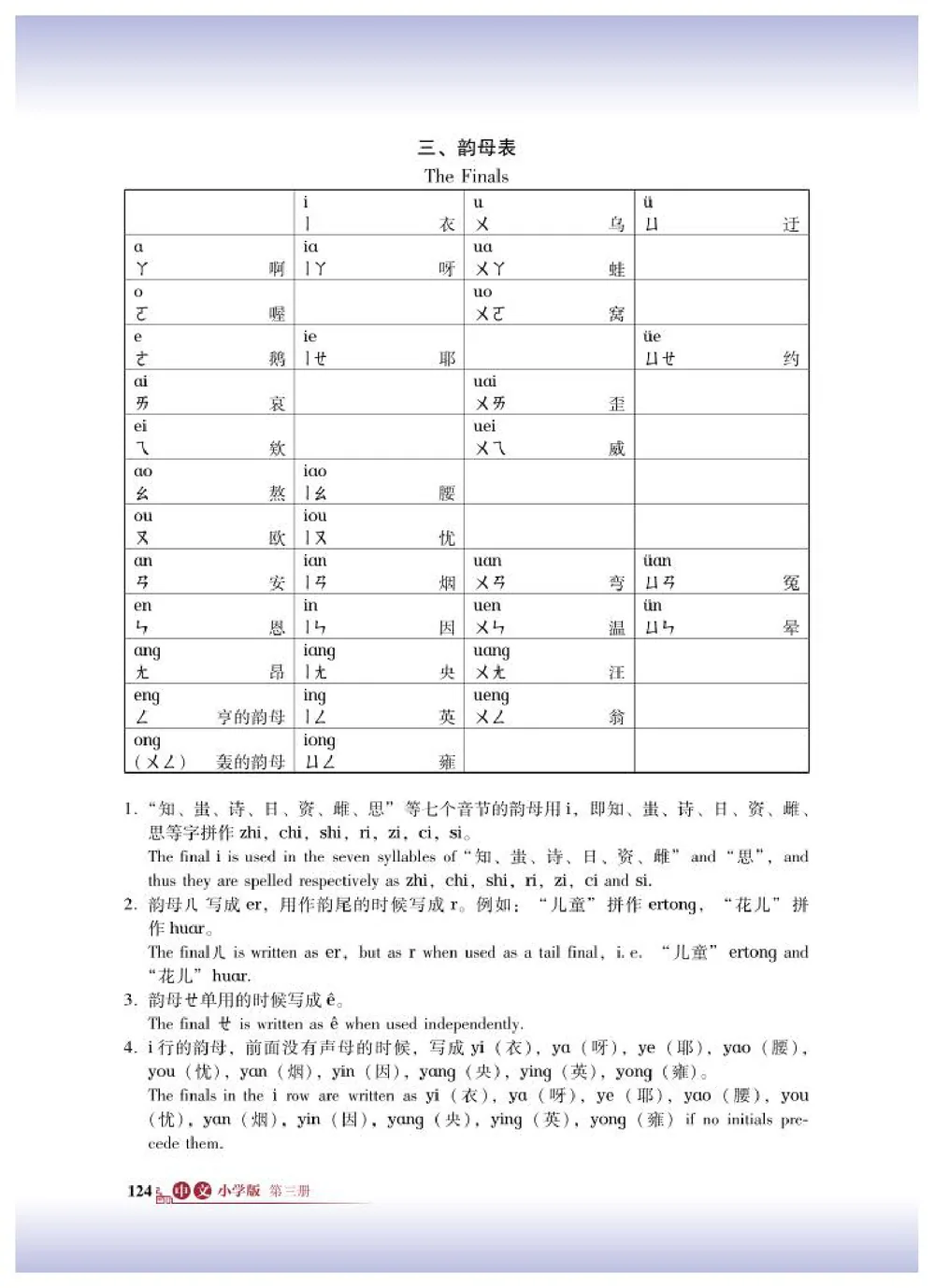
sān三、yùn韵mǔ母biǎo表
III. Table of finals
1yuán元
hēng亨de的yùn韵mǔ母
hōng轰de的yùn韵mǔ母
Izhī、“dàn知、shī蛋、rì诗、zī日、suī资、sī睢、děng思”qī等gè七yīn个jié音de节yùn的mǔ韵yòng母jí用、zhī即cuī知、shī崔、rì诗、zī日、diāo资、雕、
1. The final i is used in the seven syllables 知, 吃, 诗, 日, 资, 雌, 思
sī思děng等zì字pīn拼zuò作zhi,chi,shi,ni,zi,ci,si。
…are spelled zhi, chi, shi, ri, zi, ci, si.
Thefinal iisused in the seven syllables of“zhī知,guì贵,shī诗,rì日、zī资,diāo雕”and“sī思”,and
The final i is used in the seven syllables 知, 吃, 诗, 日, 资, 雌 and 思, and
zuò作huar。
The final ér儿 is written as er, but as r when used as a tail final, i. e.Jér儿tóng童 ertong and
The final 儿 is written er, but r as a tail final — 儿童 ertong and
"huā花ér儿"huar.
"花儿" huār.
3.yùn韵mǔ母shì世dān单yòng用de的shí时hòu候xiě写chéng成e。
3. The final ê, used on its own, is written e.
4.ixíng行de的yùn韵mǔ母,qián前miàn面méi没yǒu有shēng声mǔ母de的shí时hòu候,xiě写chéng成yi(yī衣),ya(ya呀),ye(yé耶),yao(yāo腰),
4. The i finals with no initial before them are written yi (衣), ya (呀), ye (耶), yao (腰),
you(yōu优),yan(yān烟),yin(yīn因),yang(yāng央),ying(yīng英),yong(yōng雍)。
you (优), yan (烟), yin (因), yang (央), ying (英), yong (雍).
Thefinalsintheirow arewrittenasyi(yī衣),ya(ya呀),ye(yé耶),yao(yāo腰)you
The i-row finals are written yi (衣), ya (呀), ye (耶), yao (腰), you
(yōu忧),yan(yān烟),yin(yīn因),yang(yāng央),ying(yīng英),yong(yōng雍)ifno initialspre
(优), yan (烟), yin (因), yang (央), ying (英), yong (雍) if no initials precede
uxíng行de的yùn韵mǔ母,qián前miàn面méi没yǒu有shēng声mǔ母de的shí时hòu候,xiě写chéng成wu(wū乌),wa(wā蛙),wo(wō窝):wri(wāi歪)
The u finals with no initial before them are written wu (乌), wa (蛙), wo (窝), wai (歪)
wei(wēi威),wcn(wān弯),wen(wēn温),wang(wāng汪),weng(wēng翁)。
wei (威), wan (弯), wen (温), wang (汪), weng (翁).
The finals in theurowarewritlen as wu(wū乌),wa(wā蛙)wo(wō窝),wai(wāi歪),wei
The u-row finals are written wu (乌), wa (蛙), wo (窝), wai (歪), wei
(wēi威),wan(wān弯),wen(wēn温),wang(wāng汪)andweng(wēng翁)ifno initialsprecede them.
(威), wan (弯), wen (温), wang (汪) and weng (翁) if no initials precede them.
üxíng行de的yùn韵mǔ母,qián前miàn面méi没yǒu有shēng声mǔ母de的shí时hòu候,xiě写chéng成yu(qiān迁),yue(yuē约),yuan(yuān冤),yun(yūn晕):
The ü finals with no initial before them are written yu (迂), yue (约), yuan (冤), yun (晕)
dào道shàng上liǎng两diǎn点shěng省lüè略。
…the two dots are dropped.
Thefinalsin thetirowarewrittenasyu(qiān迁),yue(yuē约),yucn(miǎn冕)andyun(yūn晕)ifno
The ü-row finals are written yu (迂), yue (约), yuan (冤) and yun (晕) if no
xíng行de的yùn韵mǔ母gēn跟shēng声mǔ母j.q,xpīn拼de的shí时hòu候,xiě写chéng成ju(jū居),qu(qū区),xu(xū虚),shàng上liǎng两diǎn点yě也
…the ü finals with the initials j, q, x are written ju (居), qu (区), xu (虚), and the two dots are also
shěng省lüè略:dàn但shì是gēn跟shēng声mǔ母n,1pīn拼de的shí时hòu候,réng仍rán然xiě写chéng成ni(nǚ女)u(lǚ吕)。
…are dropped; but with the initials n and l they are kept, as in nǚ (女) and lǚ (吕).
ju(jū居),qu(qū区),xu(xū虚)with the two dots of u being omitted;when they are used together
ju (居), qu (区), xu (虚), with the two dots of ü omitted; when they are used together
with the initials of n and 1 the two dots of ti are retained as in nii (nǚ女) and lti ().
with the initials n and l the two dots of ü are kept, as in nǚ (女) and lǚ (吕).
5.iou,uei,uenqián前miàn面jiā加shēng声mǔ母de的shí时hòu候,xiě写chéng成iu,ui,unlì。rú例niú如:niu(guī牛)gui(归),lun
5. With an initial in front, iou, uei and uen are written iu, ui, un — for example niu (牛), gui (归), lun
lùn论)。
inniu(niú牛)gui(guī归)and lun(lùn论)
in niu (牛), gui (归) and lun (论)
6.zài在gěi给hàn汉zì字zhù注yīn音de的shí时hòu候,wèi为le了shǐ使pīn拼shì式jiǎn简duǎn短,ngkě可yǐ以shěng省zuò作。
6. When transcribing characters, ng may be abbreviated to keep the spelling short.
sì四、shēng声diào调fú符hào号
IV. The tone marks
shǎng上shēng声
the third tone
qù去shēng声
the fourth tone
yáng阳píng平
the second tone (rising)
shēng声diào调fú符hào号biāo标zài在yīn音jié节de的zhǔ主yào要mǔ母yīn音shàng上,qīng轻shēng声bù不biāo标。lì例rú如:
The tone mark goes on the main vowel of the syllable; the neutral tone is not marked. For example:
mā妈ma
má麻m
mǎ马m
míng鸣ma
(yīn阴píng平)
(first tone)
(yáng阳píng平)
(second tone)
(shǎng上shēng声)
(third tone)
(qù去shēng声)
(fourth tone)
(qīng轻shēng声)
(neutral tone)
wǔ五、gé隔yīn音fú符hào号
V. The syllable-dividing mark
,0,ekāi开tóu头de的yīn音jié节lián连jiē接zài在qí其tā他yīn音jié节hòu后miàn面de的shí时hòu候,rú如guǒ果yīn音jié节de的jiè界xiàn限fā发shēng生hùn混qīng清。yòng用gé隔yīn音
When a syllable beginning with a, o or e follows another and the boundary is unclear, the dividing
fú符hào号(")gé隔kāi开,lì例rú如:piao(pí皮)。
…separated by the mark ('), for example pi'ao (皮袄).
(pí皮ǎo袄)
(a fur-lined jacket)
课本的生字表没能从扫描件上读出来,下面是这一课第一次出现的字。 The book's own 生字 list could not be read for this lesson; these are the characters it introduces.
测验 Quiz — 23 questions
做完这些题就算学完这一课。 Finish these to complete the lesson.
-
年 Choose the pinyin
-
务 Choose the pinyin
-
全 Choose the pinyin
-
议 Choose the pinyin
-
届 Choose the pinyin
-
民 Choose the pinyin
-
pī Choose the character
-
mǔ Choose the character
-
shì Choose the character
-
yā Choose the character
-
wàn Choose the character
-
wèi Choose the character
-
年(nián) What does it mean?
-
务(wù) What does it mean?
-
全(quán) What does it mean?
-
议(yì) What does it mean?
-
届(jiè) What does it mean?
-
民(mín) What does it mean?
-
(1957年11月1日国务院_体会议第60次会议通过) Which character belongs in the blank?
-
(1958年2月11日第一届全国人_代表大会第五次会议批准) Which character belongs in the blank?
-
一、字_表 Which character belongs in the blank?
-
字_(Alphabet) Which character belongs in the blank?
-
V只用来拼写外来语,少数民_语言和方言。 Which character belongs in the blank?
-
把汉字和拼音连起来 Match each character to its pinyin
-
Listen and choose the character you hear
-
Listen and choose the character you hear
-
Listen and choose the character you hear
-
Listen and choose the character you hear
-
生字卡片 Flashcards for this lesson's characters
年 nián
year务 wù
affair; business; matter全 quán
all; whole; entire议 yì
to comment on; to discuss; to suggest届 jiè
to arrive at (place or time); period; to become due民 mín
(bound form) the people; inhabitants of a country批 pī
to ascertain; to act on; to criticize母 mǔ
mother; elderly female relative; origin世 shì
life; age; generation丫 yā
fork; branch; bifurcation万 wàn
ten thousand; a great number卫 wèi
to guard; to protect; to defend拼 pīn
to piece together; to put together; to pool (resources etc); to share; to risk all; to go all out少 shǎo
few; less; to lack族 zú
race; nationality; ethnicity言 yán
words; speech; to say手 shǒu
hand; (formal) to hold; person engaged in certain types of work依 yī
to depend on; to comply with or listen to sb; according to丁 dīng
male adult; the 4th of the 10 Heavenly Stems 天干[tian1 gan1]; fourth (used like "4" or "D")般 bān
sort; kind; class韦 wéi
soft leather摸 mō
to feel with the hand; to touch; to stroke佛 fú
used in 仿佛[fang3 fu2]讷 nè
to speak slowly; inarticulate功 gōng
meritorious deed or service; achievement; result勒 lēi
to strap tightly; to bind希 xī
to hope; to admire; variant of 稀[xi1]户 hù
a household; door; family节 jié
joint; node; (bound form) section; segment; solar term (one of the 24 divisions of the year in the traditional Chinese calendar)资 zī
resources; capital; to provide思 sī
to think; to consider注 zhù
(bound form) to pour into; to flow into; to inject; (bound form) to focus (one's spirit, gaze etc) on a single point; to concentrate; (bound form) stake (in gambling)使 shǐ
to make; to cause; to enable短 duǎn
short; brief; to lack省 shěng
to save; to economize; to be frugal; to omit; to delete; to leave out; province韵 yùn
the final (of a syllable) (Chinese phonology); rhyme; appeal
课本原页,点图看大图。 The printed pages this lesson comes from — tap to enlarge.